Sunday, 6 December 2020

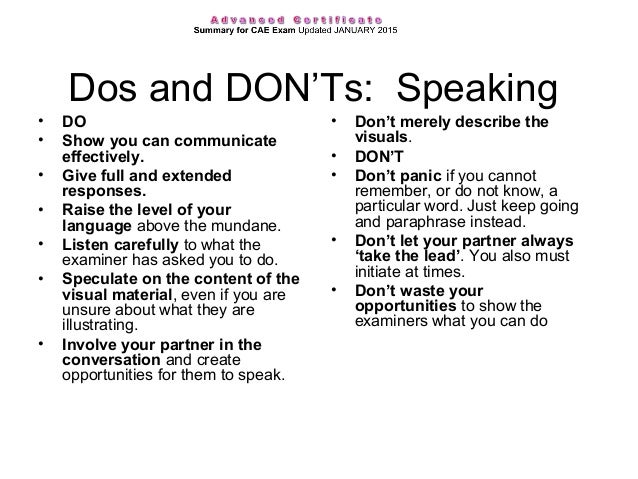
Collaborative Task: Do's and Don'ts and Useful phrases


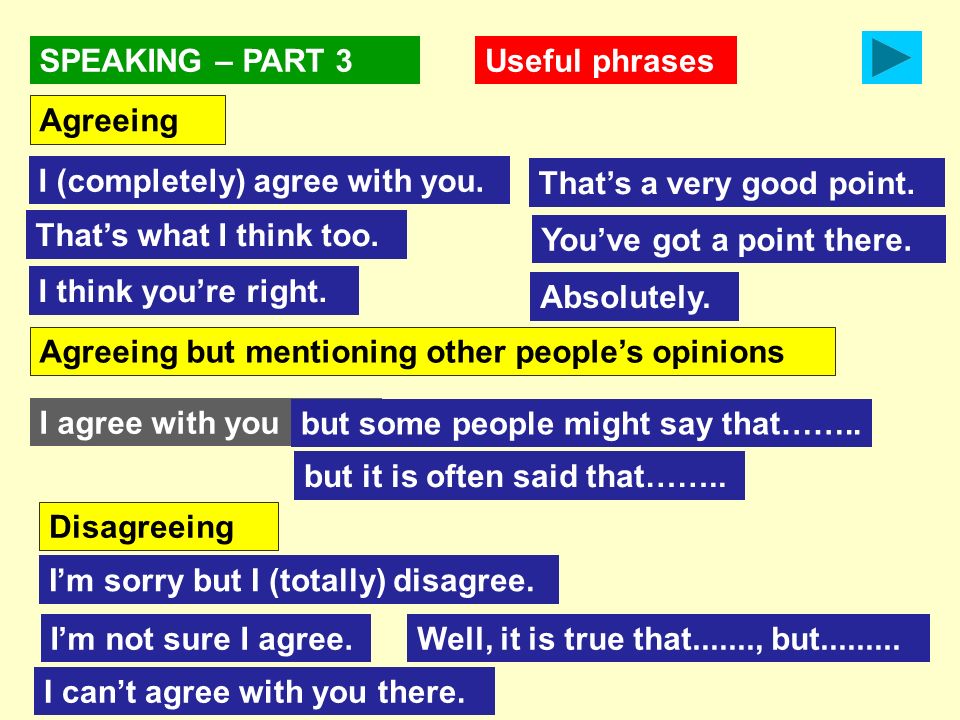
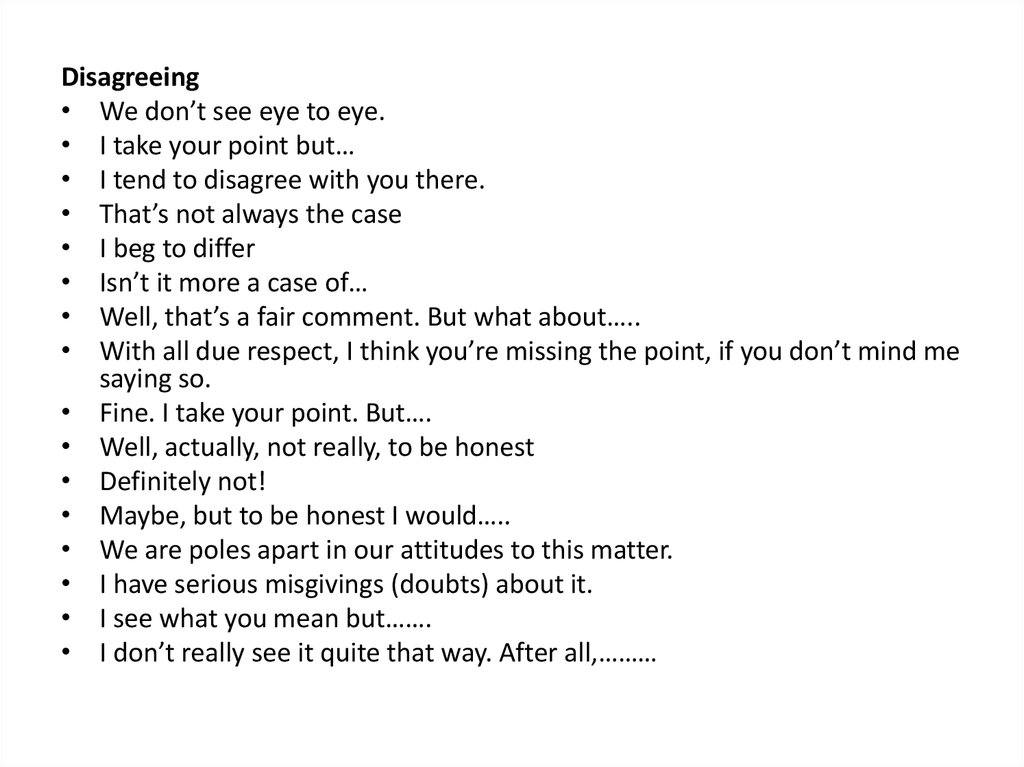
Resultado de imagen para CAE SPEAKING PART 3 USEFUL PHRASES


Resultado de imagen para CAE SPEAKING PART 3 USEFUL PHRASES
Imagen relacionada

Resultado de imagen para CAE SPEAKING PART 3 USEFUL PHRASES for agreeing and disagreeing


Resultado de imagen para CAE SPEAKING PART 3 USEFUL PHRASES for agreeing and disagreeing

More on fluency and useful language for speaking

Examiners will be evaluating your ability for the following areas:

*Initiating and responding. It is really important to be able to start a conversation with your partner/s and responde to questions with the appropriate extent!You should be able to form simple questions well. The key is to use simple questions such as, “Do you enjoy watching TV?” and to focus on giving a simple, fluent and extended answer (20-30 seconds). Your answer in the exam should be with mostly simple grammar forms that you have practiced during the course and the vocabulary should be only what you are sure of using. DO NOT EXPERIMENT WITH NEW WORDS IN THE EXAM!
  
*Using question tags: question tags are used as a way of forming informal questions, asking for confirmation or agreement.
I reckon that it is an easy exam, don´t you?
I think this is the best option, isn't it?
  
*Giving reasons for your answers, justifying your opinions, giving concrete examples:. You should always give a reason for your answers with a simple connective such as because, but or for example. This will help you to extend your speech and also, to show confidence and fluency.

*Making suggestions: An important part of the exam is suggesting. You need to be able to suggest different options to later talk about them. For example, Why don't we talk about…? How about (…ing)?

*Negotiating towards a conclusion, result or outcome: It is very important to negotiate an outcome in Part 3 and 4. This means to give a result. What you need to do is find a conclusion by showing agreement or disagreement. A good thing to know is how to express strong agreement or disagreement.
Agreeing: 
  • Exactly!
  • I couldn’t agree more!
  • You took the words out of my mouth!
  • I see your point.
  • I get what you mean.
  • We see eye to eye.
  • I understand your point of view.
Disagreeing: 
  • Not really!
  • Not quite!
  • I'm afraid I don't quite agree on that point!
  • I'm afraid I see it differently.
  • Really?
  • What are you on about?
  • I can't agree with you on that.
More useful language for interaction:

  • In my opinion, …
  • In my eyes, …
  • To my mind, …
  • As far as I am concerned, …
  • Speaking personally, …
  • From my point of view, …
  • As for me / As to me, …
  • My view / opinion / belief / impression / conviction is that
  • I hold the view that …
  • I would say that …
  • It seems to me that …
  • I am of the opinion that …
  • My impression is that …
  • I am under the impression that …
  • It is my impression that …
  • I have the feeling that …
  • My own feeling on the subject is that …
  • I have no doubt that …
  • I am sure / I am certain that …
  • I think / consider / find / feel / believe / suppose / presume / assume/reckon that …
  • I hold the opinion that …
  • I dare say that …
  • I guess that …
  • I bet that ….
  • I gather that …
  • It goes without saying that …
Coming to a conclusion: 

  • In conclusion, ...
  • To sum up, ...
  • Finally, ...
  • As you can see, that’s why I think we should go for… , 
  • In brief, ...
  • On the whole, ...
  • All in all, ...
  • To round up, ...
  
*Expressing purpose; It is important to know how to state the purpose or the reason for something: Here are some examples:
Infinitive: I am learning English to get a good job.
So that: I am learning English so that I can get a good job.
In order to: I am learning English in order to get a good job.

*Developing and extending speech. An important part of speech is being able to develop you answer. This is when you make a topic more interesting by linking it to your own ideas and opinions. It is best to use the 1st or 2nd conditional.
E.g. If we go to the zoo, we will see lots of interesting animals and I love animals. But we won't go unless it stops raining.

*Linking ideas: In speaking Part 2 and 4 it is a good idea to start linking ideas. Use connectors and expressions such as: 

  • As/Like you have said…, 
  • According to you…, 
  • With respect to what you have said about…
  
*Persuading or convincing people to agree with you is important in Part 2. When you are talking about the situation, it is important to know how to convince your partner to agree with you. It doesn’t matter if you agree or not but you need to express your opinion so that they might agree with you.
Persuading: Don´t you think we should…? Wouldn't it be a good idea to…?
 You need to be able to express changes in likes and dislikes (past and present). You need to be able to talk about how you opinions, likes and dislikes have changed. A great way is by using USED TO. This should that something has changed.
E.g. I used to do sport every day but now I only do it once a week.
*There are various ways of saying like, try to vary them. It is better to use the gerund (ing) after them.
LIKE = enjoy, love, be keen on, be fond of, be into, be a fan of, be big on, be crazy about
DISLIKE = hate, detest, loathe, despise, can´t stand

*Speculating is needed to talk about things that are probable or that maybe will occur. Use modal verbs such as may/might/could. This will add a degree of uncertainty to your speech and allow margin for discussion.

The key to doing well in this part of the exam is to give a good first impression. You must speak with extended, fluent and confident answers.

Friday, 8 November 2019

Speaking Anxiety

Did you know that....?


*the fear of speaking in public is called glossophobia.

*it is the single most common phobia (fear)

*approximately 75% of people experience this

*you are not alone in your fear

*you cannot eliminate your fear–but you CAN manage and reduce it.

Resultado de imagen para inspirational mantras to use before speaking in public

Get ready to speak!


*Prepare carefully–know you're in for!


*Practice–rehearse alone, in the shower, in front of the mirror, with family or friends!


*Challenge negative thinking–make 3 x 5 cards of positive inspirational thoughts or mantra.s

*Expect positive reactions–expect success!


*Employ breathing exercise strategies.

Imagen relacionada


*Eat for success–foods containing tryptophan (dairy products, turkey, salmon) and complex carbohydrates tend to calm the body. Eliminate caffeine, sweets, and empty calories.


*Sleep for success–know and get the number of hours of sleep you need for optimal performance.


 Imagen relacionada

The Day of the interview

* Eat several hours before the talk–not immediately before!

*Dress for success–your success! Dress comfortably and appropriately for the situation. Look your best!
*Challenge negative thinking–Continue positive thinking!
*If you need to, express your fears to a friend.
*Review 3 x 5 cards of inspirational thoughts!
Imagen relacionada
*Practice one last time!
*Hold something in your hand that you can play with or squeeze tight immediately before the talk to reduce adrenaline levels. 
Resultado de imagen para rosario para rezar
Resultado de imagen para squeezing ball
    • Employ anxiety reduction techniques
    • Aerobic exercise
    • Deep muscle relaxation
    • Visualization strategies
    • Deep, rhythmic breathing (4 hold 7) 
*Use the restroom a while before the interview.
*Take a bottle of water along.
 *Interpret anxiety symptoms as excitement
*Appropriately regulate your voice
    • Speak clearly–enunciate
    • Open your mouth–do not mumble
    • Slow down if necessary
    • Lower your voice–speak from your diaphragm
    • Project your voice–use energy when you speak
    • Use appropriate gestures and body language 

Public Speaking Anxiety Tips

Friday, 13 September 2019

Topics for Discussion: Parts 4


Imagen relacionada

The DIFFICULT part about the CAE exam is that the units of study are not fixed; you can get questions about many topics in Part 4. The lucky part is knowing all of the information in each part and using your skills to talk about unfamiliar topics.

Hobbies and free time
Travel and getting around
Education and learning styles
Success and failure
Work and obligations
Money and shopping
Time
Eating and drinking
Health and fitness
People and their lives
Technological advances, communication and the media
Wildlife and the environment
Life, crime and society

*POSSIBLE QUESTIONS TO PRACTISE:

Sport and leisure
  • How often do you get around to working out?
  • What are the pros and cons of doing physical activity?
  • Have you ever had an amazing sporting experience?
  • Are there any times that you would rather relax to unwind from the stress of your routine rather than be active?
  • What has been your greatest sporting achievement?

Success and failure
  • What would you consider to be your greatest achievement?
  • What is success? Define it.
  • Is money an essential part of success nowadays?
  • Can massive failures ever contribute towards a person's success?
  • Have you ever failed miserably at something?

Communication
  • How has the internet changed the way we communicate?
  • What negative effects has the internet had on our social lives?
  • Are you keen on talking on the phone? Why (not)?
  • When was the last time you sent a personal letter?
  • Which forms of communication will become obsolete?

Health
  • How important is our diet in living a healthy life?
  • Would you ever consider having cosmetic surgery?
  • Do you visit the doctor as often as you should?
  • Are people aware of the dangers of cigarettes and alcohol?
  • What is the best way of preventing or dealing with drug addiction?

Crime
  • Do you know anyone who has been a victim of crime?
  • Should any illegal substances such as cocaine be legalized?
  • What is the most serious crime one can commit?
  • What can we do to ensure that youngsters don't get involved in criminal behaviour?
  • What is the most common crime in your region?

People and their lives
  • What are the benefits of having a fixed routine?
  • Are you a fan of taking up new activities?
  • Would you say you are more of an early riser or a night-owl?
  • When was the last time you made drastic changes to your daily routine?
  • What is your opinion on flexi-time at work?

The environment
  • Would you say that young people concern themselves with environmental issues?
  • Are there any types of natural disaster that occur in your country?
  • What can be done to prevent global warming?
  • Are national governments doing enough to stop the effects of climate change?
  • Do you think it should be obligatory to recycle, punishable with a fine?

Time
  • What measures do you put in place to make sure you use your time effectively?
  • Do you ever procrastinate? Why (not)?
  • Name a situation in which you need to kill time
  • Do you enjoy hanging out with your family?
  • What types of activities do you need to take your time over?

Shopping and buying things
  • What´s your view of online shopping?
  • Do you think shopping on the internet will ever overtake the conventional way of shopping?
  • What possible drawbacks could shopping online have?
  • Do you reckon that people spend money on things that they do not need nowadays?
  • When was the last time you spend an arm and a leg?

Work and our careers
  • Is it a good idea to stay in the same job your whole life or to try different things?
  • Have you ever experienced great success at work?
  • Would you ever consider changing career paths?
  • Have you ever been fired from your job? Why?
  • Have you ever been unemployed for a long period of time? How did/would you feel?

Education and our own development
  • Is it essential to get a degree in today's society?
  • Which types of degrees are better, vocational or academic?
  • Would you dare say that you are a good student?
  • What can students learn from failing exams?
  • How could the education system be improved in your country?

Travel and tourism
  • Are you keen on travelling alone or with others?
  • What are the possible difficulties faced when travelling abroad?
  • Is travelling to a different country the best way to learn a language?
  • Have you ever had a nightmare trip? Why?
  • Due to the improvement of living standards, has travelling become easier in recent times?

Technology
  • Would you say that technology has improved our lives?
  • What are the possible risks of using the internet?
  • What can be done about addiction to technology?
  • What are the advantages and disadvantages to owning a mobile phone?
  • In which ways can technology impede our progress at school/university/work?

Friends, family and relationships
  • Have new technologies made us more or less sociable?
  • Would you say you value the opinion of your friends or family more?
  • Do you get on with all the members of your family?
  • Do you need to cut down on the amount of time you spend with anyone you know?
  • How can your family help you cut out behaviour that can be detrimental to your progress?

Friday, 16 August 2019

Assessment

Resultado de imagen para cae speaking test assessment

Resultado de imagen para cae speaking test assessment
In the Speaking test, there are two examiners: interlocutor and assessor. 

The interlocutor speaks to you and awards a mark for your performance as a whole, using the Global Achievement scale. 

The assessor listens to you and awards marks for five individual criteria: 

• Grammatical Resource 
• Lexical Resource 
• Discourse Management 
• Pronunciation 
• Interactive Communication. 

→Now follow the link to have a look at the Assessment Scales for CAE Speaking Test:

http://readeralexey.narod.ru/ENGLISH/Assessing_speaking_level_c1_1_2.pdf


***Task: 

Use the scales to give a mark to your classmates as they are evaluated in a mini-mock interview.

Marks out of 25

Friday, 28 June 2019

Collaborative Task

Example questions:

Resultado de imagen para cae part 3 speaking

Resultado de imagen para cae part 3 speaking
Resultado de imagen para cae part3 decisions


Cambridge English: Advanced (from 2015), Raphael and Maude


Resultado de imagen para cae part 3 speaking


CAE Speaking Part 3 Explained


CAE SPEAKING PART 3: ADVICE

The third part of the CAE exam is based on interaction with your partner. You need to focus on developing a simple, yet fluent conversation with your partner, in which, the examiner will assess your ability to “initiate and respond, develop a topic, negotiate an outcome”.


There are some simple things that you can do to make this part of the exam a lot easier:


*Practice asking questions and ask all types of questions (short, full, negative, question tags).

*Use hypothetical grammar forms (2nd and 3rd conditional, wish, if only) to help develop the content.


*Make your points and give reasons for your answers. It is important to use examples like past experiences to reinforce your opinions.

*Cover all the ideas you are given in the task.

*Disagree politely! At the beginning, it is much easier if you purposely disagree with your partner and offer a different perspective. Then try to come an agreement. 

*Try to relax and enjoy this part of the exam. If it seems like a natural conversation with a friend, it will get a much better grade. This part of the exam is not so concerned with accuracy, but interaction and fluency. You want the examiner to think that you speak English on a daily basis and that you enjoy using it.


Friday, 29 March 2019

Part 2, Long Turn Practice #1: COMPARING AND CONTRASTING PHOTOS

 Resultado de imagen para CAE SPEAKING PART 2

     In part two of the Cambridge English Advanced Speaking test, you are given a piece of paper with 3 photos on it. The photos are almost always about people. 
You have to talk about 2 of the pictures, on your own, for a minute. Then the examiner will ask the other candidate a question about your pictures. Next, the other candidate will have to talk for a minute about some different pictures, and you will be asked a question about those pictures. The technique for answering this follow-up question is to respond in about 3 sentences and try to show off your vocabulary.

Today we will focus on what to say in your 60 second 'long turn'. In the exam, you don't get time to plan or make notes, so now is the time to prepare! 

Do's and Don'ts 

  • You are asked to talk about TWO pictures. Choose two and say nothing about the third one.
  • Do not simply describe the pictures: "I can see a car. The car is red. There is a tree."  You aren't asked to describe them. Compare the pictures - that's explained more below.
  • Don't waste the first five seconds by explaining which pictures you have chosen. Just start comparing the pictures! (If you feel you have to make it clear, you can point to the pictures you have chosen.)
  • Dead air ... is still a crime! You get 60 seconds to do this task. Use all of it! When your time is up the examiner will stop you.
  • The examiner tells you what to do, but the task is also printed on the page with the photos. Refer to that page to make sure you talk about both bullet points.
  • While you are comparing the photos, try to look at the examiner and the other candidate from time to time. It's hard because you have to look at the pictures, but try not to talk to the photos - make eye-contact!


ALWAYS BE COMPARING!

*When the examiner gives you the instructions for the task, he or she will always start, 'I'd like you to compare two of the pictures and say...' 

Comparing is the heart of the task!

If you aren't comparing, 

you aren't scoring points.


Comparing means saying
what's the same in your chosen pictures and what is different. There are many ways
you can do that,
but the easiest way is
to use the magic CAE words:

The Three Magic Words
  • Both ...
  • Whereas ...
  • While ...
***Let's try with these photos!

*Example of what to say:
"Both pictures show men using phones. Whereas in this picture the man is wearing a suit, in this picture the man is dressed in some kind of traditional costume. While the businessman is sending a text or checking his portfolio, the man in the fluffy hat is checking his voicemail."
There are always lots and lots of possible comparisons:
 - indoors/outdoors
-day/night time
-cheap/expensive
-old/new
-old/young
-traditional/modern 

Even if you have no imagination, you can practice finding similarities and differences before you get to do this task. 


Task 1: Instructions: 
These photos show situations in which someone is taking a photograph. Compare two of  the photos, say how difficult it might be for photographers to do their job in these situations and who might be interested in these photographs.


Resultado de imagen para photos to compare and contrast CAE PART 2


Task 2: Instructions:
These photos show people having a quiet moment. Compare two of the photos and say what picture best illustrates the idea of peace and quiet and why moments like these might be necessary in life.
Imagen relacionada
Task 3: Instructions: 
These photographs show people using flags. Compare two of the photographs and say why flags are being used and what effect they might have on the people who used them.
Imagen relacionada


Video Guides to watch 
on your own: